On July 13th, 2024 I was contacted by Dr. Marco Schirippa, Assistant Professor of Percussion at Central Michigan University to participate in his PIXEL MASTERWORKS project. He was assembling a collection of video game music composer to create new works for marimba, to be performed in a premiere concert the following year.
As a violist, pianist, and lover of classical music I was extremely excited by the chance to create my very first piece of professionally commissioned performance music.
It's not every day that a cold email turns into one of the proudest moments of your career - but I'm super glad this one did.
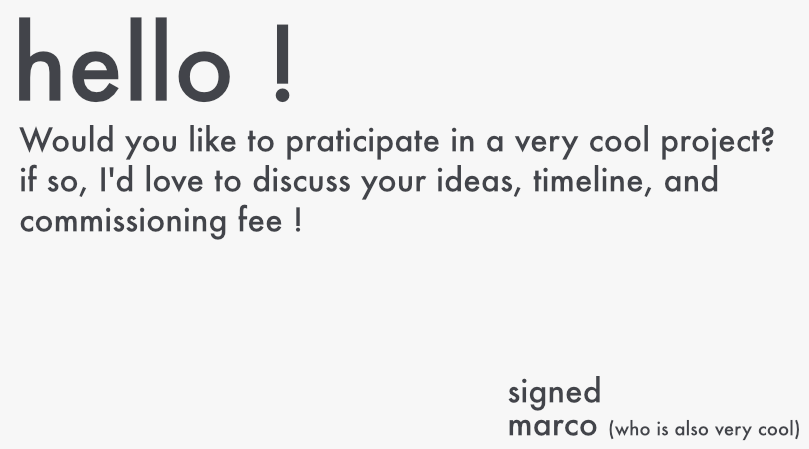
the email (artist’s rendition)
The following is a case study on how I wrote Intro & Loop
Listen to it above and Read the program notes here
Because this was my first time writing for marimba, I thought a fine place to start writing this piece was with research. I looked up a few works for marimba and discovered the pieces Stroboscope, by Eric Sammut and Chain, by Kazunori Miyake. I listened to both and purchased the sheet music for each to get a better idea of how they worked.
As a viola player, I know that the genre of classical music for a single instrument can feel less robust and "full" than music written for string quartet, a full orchestra, or even solo piano. While both of these works are stunning examples of how to do it well, I knew that my first outing with the instrument wouldn't necessarily arrive at such great heights so soon. I wanted to play to my strengths.
With that in mind I thought, "What if I added an echo effect to the instrument?" This, I thought, would be an excellent way of making the piece sound properly full. This is also a common approach that I take in my video game writing; instead of thinking of an instrument and its effect as two separate things, I think of the composite of the two as a brand new, unique instrument itself. I reflected this in the way I named the piece - it's noted as being for "marimba with electronic delay," not "marimba *and* electronic delay," since they're being treated, together, as one sound. I also insisted that Marco not present any clips of the piece without a delay applied for this reason (thank you Marco!!!)
Continuing from there, I asked myself, "If I were writing for an instrument with a delay pedal, what kind of music would I write?" I opened my music software, brought up a piano (being careful not to play with too many notes at once), added a delay effect to it, and thought, "Well, probably something like this" as I played the piece's opening figure.
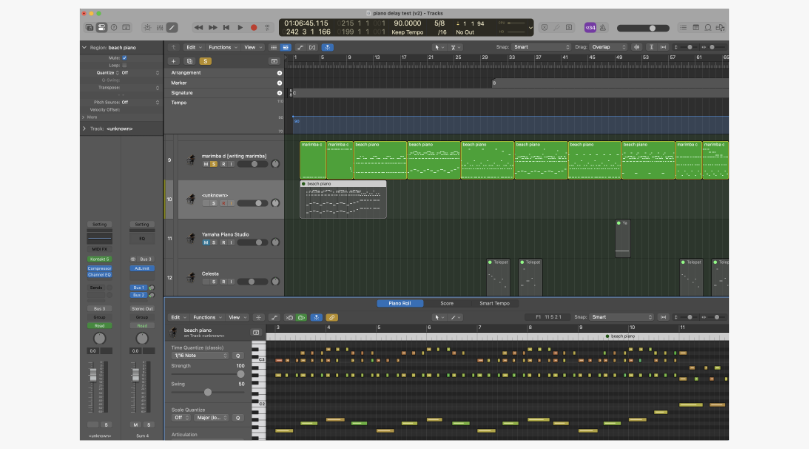
an image of Logic, the software I used to write the piece
My next steps were to substitute the piano with a high-quality marimba sound (which I purchased from 8dio) to get a better idea of how everything would sound and explore the idea for what might be interesting for the audience to hear and see. I thought the idea of Marco jamming away at the rhythm while reaching across himself to play melody notes would be very interesting and that became the basis for the next section.
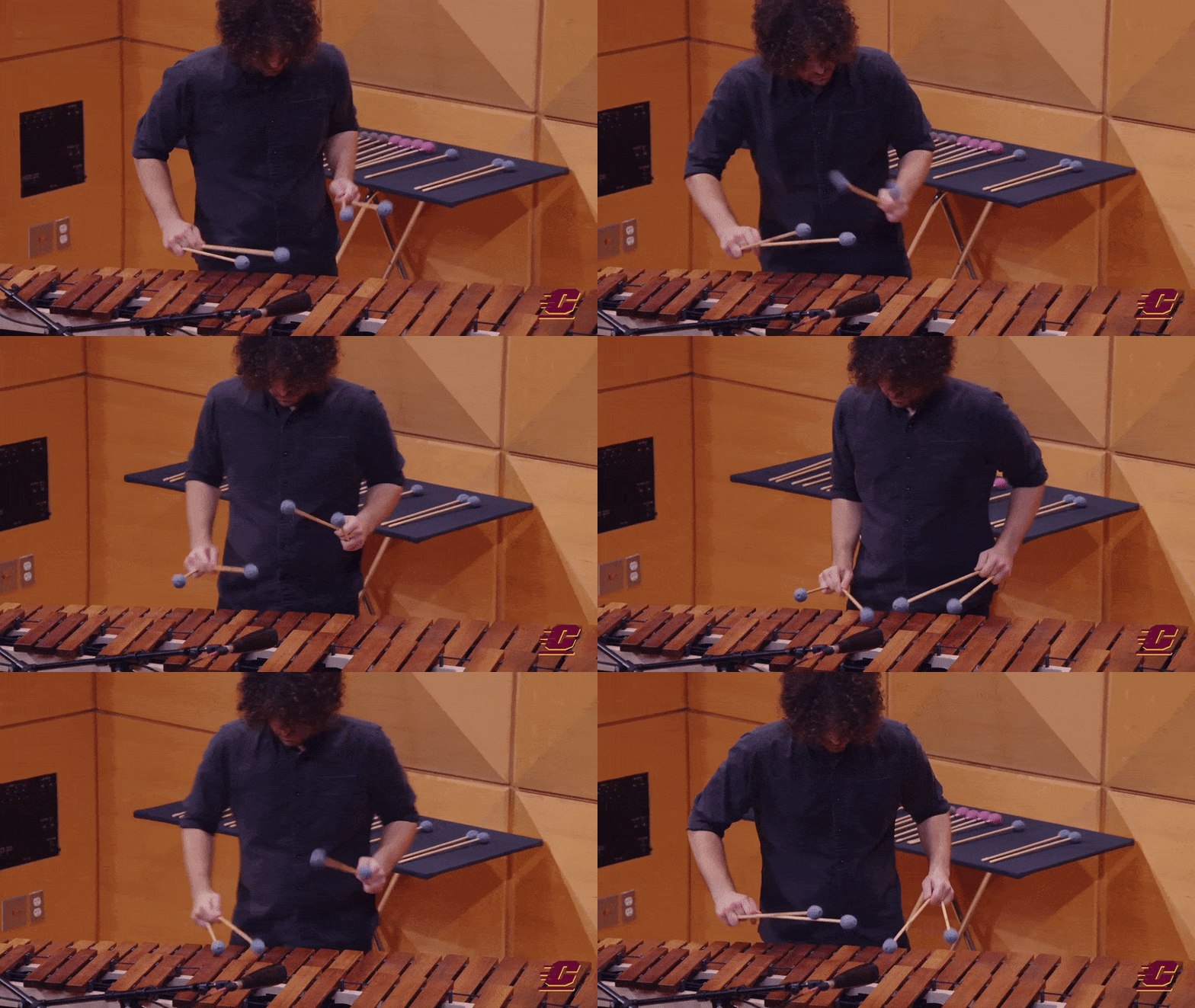
Marco crossin’ over
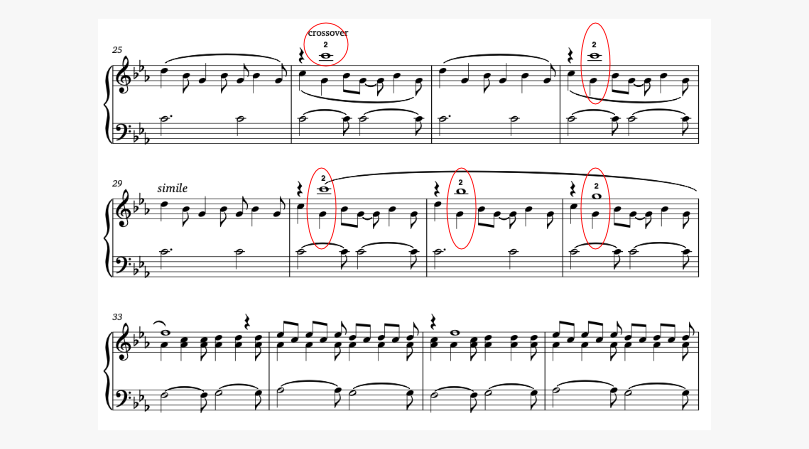
sheet music showing the crossover | 00:49 in the performance
After exploring that, I came up with a groovy “ostinato” - a part of the music that repeats over and over again - and wrote a melody on top of it. I didn't have anything meticulously planned out for this section and instead chose to let my intuition as a composer take over. I call this the part where I "let the music write itself."
Elizabeth Gilbert discusses an idea similar to this in her amazing 2009 TED talk, "Your elusive creative genius"; she discusses how the prevailing idea of the past was that "genius" wasn't something that existed within you, but was instead something (or someone - a spirit, perhaps) that would descend from the heavens and gift you with creative ideas for your art. In a more practical sense, I think that the sum total of your exposure to, experience with, and study of an art subconsciously influences everything you make. When you're creating in a "flow" state, you're tapping into that collection of inspiration. It's something I try to do in most of my work and those intuitive sections of my music tend to be some of my (and my audience's) favorites.
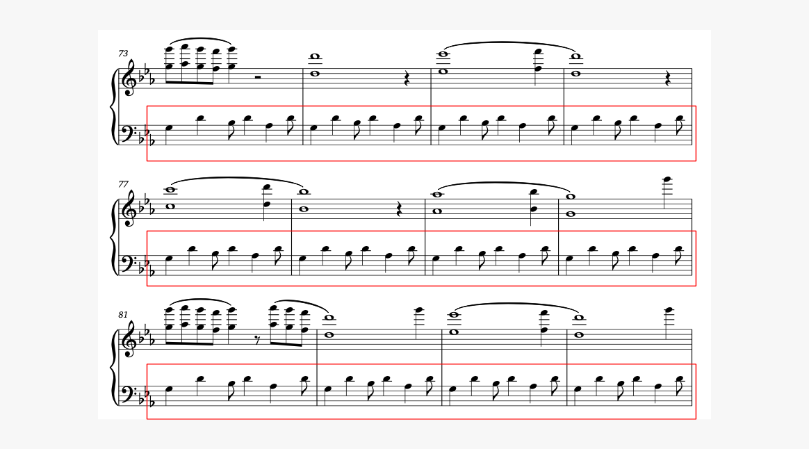
the ostinato | 2:25 in the performance
One of the fun things about writing an ostinato is that your brain will “accept” that the ostinato part belongs with the rest of the music, even if it sounds dissonant or “out of tune” with the other parts. I noticed that there was a little “clash” that occurred naturally between the ostinato and the melody towards the end of the idea - two notes that are right next to each other play at the same time, creating a somewhat harsh sound - and I thought it was interesting that it had happened and just as interesting that I’d barely noticed it. I decided to draw attention to the “clash” by repeating it a few times.
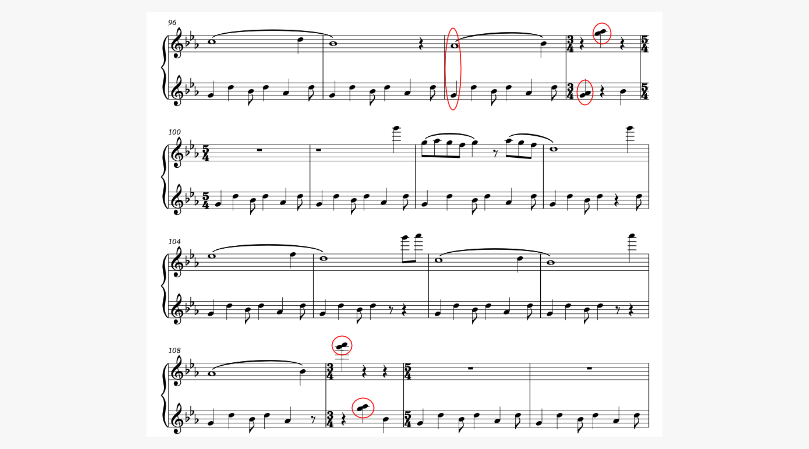
the clash | 3:12 in the performance
The next section of the music is another part that “wrote itself.” There’s a fairly strong harmonic shift that happens (at 3:42 in the performance), but I didn’t have any particular thoughts in mind when I chose those chords, other than “hey, this sounds neat.” The return to the beginning of the piece wrote itself as well; it’s extremely common in both classical music and video game music to return to a piece’s opening section, so it only made sense for me to do so here.
Part of the origin of the Loop section comes from our writing process for the piece. Since I’d never written for marimba before, I decided that I’d make a habit of regularly passing the music to Marco to ensure that everything was possible for a live player to perform. I had concerns that I had made the piece too difficult, but he assured me that everything was playable.
Of course, upon hearing this, I felt freedom to make things a bit more intricate… which did lead into a bit of a difficulty spike (and the creation of a section that was initially far too difficult - thankfully, Marco helped me reign it in quite a bit).
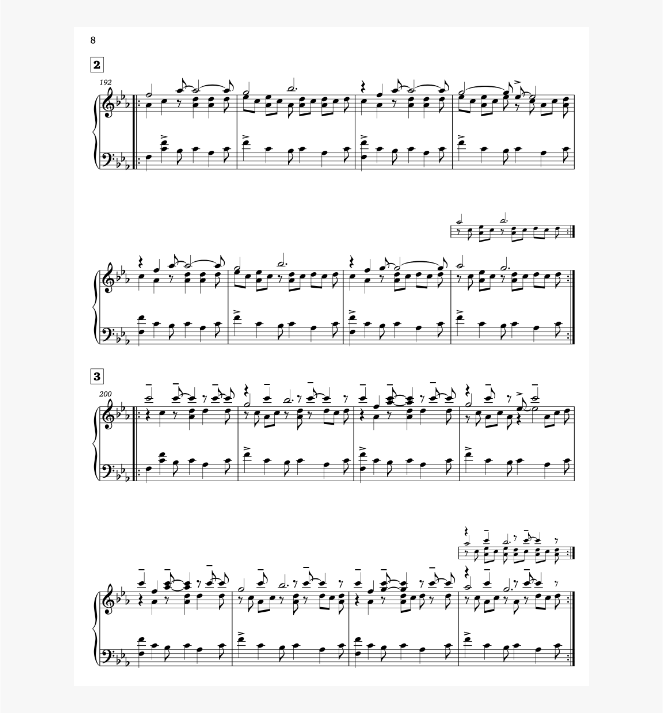
a page from the “Loop” section
When I began writing Intro & Loop, I knew that I wanted to do something to artistically reflect the fact that PIXEL MASTERWORKS is a project that exists at the intersection between video games and classical music.
In the early history of video game music, the pattern set by some of the most popular examples of that work is what I refer to as the "classical" video game music form. This was a form popularized by composers like Koji Kondo (the writer of the Super Mario Bros. theme), Jun Ishikawa & Hirokazu Andu (who worked on the Kirby series), and other "retro" composers.
A key element of that form is that the music often begins with a short introduction that plays a single time, followed by the main body of the piece, which loops endlessly, unless its interrupted by a player's action - such as the player dying, pausing the game, or progressing to a new level with different background music. I think of these distinct segments as the "Intro" and "Loop" segments of the piece. If you're familiar with the 7 note introduction of the Mario theme, then you're familiar with the sound of one of these "Intro" sections - though, technically, the Mario theme does loop in its entirety (a fact which I misremembered in my program notes for the piece).
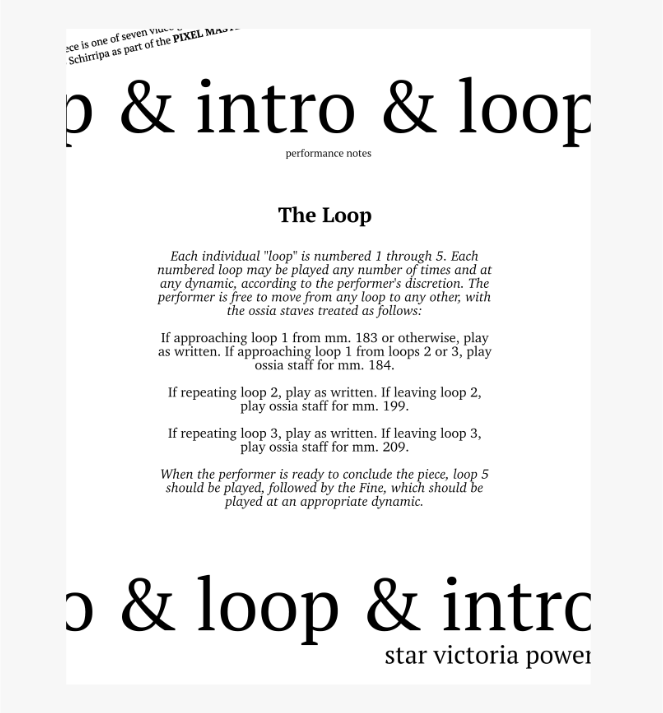
performance notes for the Loop section
In either case, the concept still stands, and I sought to imitate these elements with my writing.
In “Intro & Loop” the performer plays the role of a player playing a video game. They progress through the Intro section as expected before arriving at the Loop, at which point the sound of the music is determined by the input of the performer. The performer has the freedom to move through various sections of the music in whatever order they choose, at whatever volume they like, and for as long as they wish. This is analogous to my work as a video game music composer - while there are many decisions that I can make through my music, the ultimate way that it will sound in game is determined by how a video game player chooses to progress through it.
Lastly, the title of the piece is a reference to both traditional classical music writing and my process as a video game music composer. Traditionally, classical music pieces were often presented without emotionally descriptive titles; they were instead given names that were factually descriptive. The fifth symphony that Beethoven wrote is in the key of C minor, so its formal title is, “Symphony No. 5” and it is often referred to as “Symphony No. 5 in C”
I often don’t begin with emotionally descriptive titles for my video game music, but it’s necessary in many contexts for my files to be clearly named and delivered in a format that a programmer is able to implement into a video game. I’ve often delivered two distinct files to game developers for each piece of music, divided into the “Intro” and “Loop” files and named as such. Thus, the factually descriptive title of this piece is, “Intro & Loop.”
Overall I am extremely satisfied with how the piece came out and Marco’s wonderful world premiere performance. If you haven’t had a chance to listen yet, check it out here. You can also find out more about Marco’s work and the PIXEL MASTERWORKS project here, stream the entire concert at this link, or get in touch if you’d like to work together.